
Innovation Showcase logo Innovation
Showcase
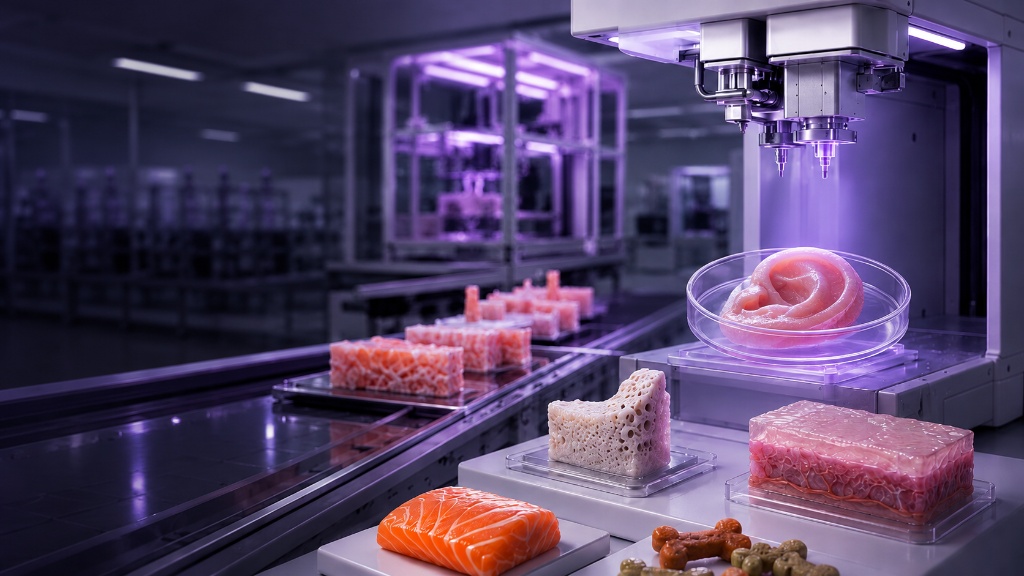
Quantis biofabrication line: a 3D bioprinter building a human ear in a Petri dish, alongside salmon, a bone block, a scaffold and 3D-printed pet snacks on the conveyor
Official logo — Beyond 3D Printing Innovation Showcase

BEYOND 3D PRINTING

3D bioprinting in real applications — not in slides.

From tissue regeneration to 3D skin for cosmetics, from printed foods to functional pet snacks: an applied showcase where biofabrication takes shape in front of those who decide, develop and invest.

Sales closing soon — only 7 seats left, secured by order of payment.

Date

September 11, 2026

Time

1 PM to 6 PM

Venue

Bayer · São Paulo

Presented by
QUANTIS· BioEdTech· MORPHÊ
Manifesto

The future of innovation won't just be studied. It will be designed, biofabricated, tested, demonstrated and connected to real opportunities.

The Innovation Showcase is not a traditional lecture event. It is a technology demonstration platform — a curated journey where applied science, advanced biomaterials and 3D models leave the bench and take shape in front of those who decide, develop and invest.

Here, biofabrication and 3D bioprinting meet industry and market. Each station is a proof of concept; each conversation, a potential route to co-development.

Applied science

Technologies with scientific rigor and translational purpose, ready for real-world application.

Real demonstrations

Biomaterials, 3D models and biomimetic microenvironments demonstrated live.

Strategic connections

Qualified encounters between academia, industry and co-development partners.

Why this event matters

Three-dimensional structuring is no longer a promise — it became a competitive advantage.

Biofabrication, 3D bioprinting, biomaterials and 3D in vitro models are redefining how research, validation and development happen in health, food, veterinary, dentistry, cosmetics, aesthetics and cellular agriculture. More biological relevance, less experimental rework and new routes to market.

Smarter validation

3D in vitro models and biomimetic microenvironments bring assays closer to human biology, raising the relevance of results.

Experimental efficiency

Less rework, shorter development cycles and faster decisions on safety, efficacy and differentiation.

Translational development

From bench to application: biomaterials and scaffolds with the potential for scalability and clinical and industrial impact.

New market opportunities

Technical differentiation that opens up product categories, partnerships and entry into previously inaccessible markets.

Who this is for

A journey designed for those who decide, develop and connect innovation.

We bring together the leaders and specialists who turn science into product, decision and market — from the lab to corporate strategy.

Innovation & R&D

  • Innovation directors
  • R&D leaders
  • Technology development managers
  • Experimental validation specialists
  • Leaders in innovation efficiency and cost reduction

Health & life sciences

  • Academia and research
  • Human health
  • Oncology
  • Dentistry
  • Cosmetics and aesthetics
  • Veterinary medicine

Food, market & capital

  • Food and foodtech
  • Cellular agriculture
  • Ingredients, flavors and extrudable formulations
  • Education and training
  • Hubs, investors and strategic partners
For Pharma

Fewer assets that fail late. More decisions with human relevance.

The pipeline bottleneck isn't a lack of molecules — it's the rate at which they fail after years and hundreds of millions invested. Biomimetic 3D models and organoids exist to bring that decision forward: to kill what doesn't work sooner, not later.

Regulatory — no longer a "nice to have"

The FDA Modernization Act 2.0 (Dec 2022) removed the requirement for animal testing to approve new drugs, authorizing NAMs (New Approach Methodologies — organoids, organ-on-chip, 3D in vitro models). In Apr 2025, the FDA roadmap declared the goal of making animal studies "the exception, not the norm" in preclinical safety assessment within 3–5 years. Those who adopt alternative models now stay ahead of the regulatory curve.

~90%

of candidates entering clinical trials fail before approval

Reviews of clinical trial attrition

~US$ 2.6 bn

average cost to bring a new drug to market, over 10–15 years

Tufts Center for the Study of Drug Development

~50%

agreement between animal and human response in toxicity — half the time the animal model does not predict the human

Systematic review of preclinical studies

The pain today

Animal and 2D models delay the reading of efficacy and toxicity: costly failures appear late, already in the clinical phase, compromising budget, timeline and portfolio priority.

The gain

Human 3D models (organoids, spheroids, tumor microenvironments) screen candidates with greater biological relevance and anticipate safety/efficacy signals — reducing experimental rework and assets that only fail after years.

The pain today

Billions per year are lost in oncology trials that fail due to poor translation of preclinical models to the real human response.

The gain

Bioprinting and 3D culture platforms allow building microenvironments closer to human tissue, raising the decision-making power in oncology, ADME/Tox and compound screening.

What you take back

It's not a lecture: it's a contractable starting point.

Technical report of the demonstration

A record of what was demonstrated and how to apply it to your use case.

Proof-of-concept scope

A viable slice of your problem to test in a 3D model.

Co-development roadmap

Steps and responsibilities for a joint R&D front.

Direct technical contact

A dialogue with those who build the technology — not with a sales funnel.

For Cosmetics

Efficacy proven on reconstructed human skin — without relying on animals.

The market no longer asks for "hypoallergenic" — it asks for a defensible claim. Reconstructed human skin models and 3D structuring let you prove the safety and efficacy of actives and formulations with data, answering both the regulatory requirement and the cruelty-free consumer at the same time.

Regulatory — the norm has already changed

In the European Union, Regulation (EC) 1223/2009 banned the testing of cosmetic products on animals since 2009 and the marketing of animal-tested products since March 2013. Reconstructed human skin models already have methods validated by the OECD (irritation, corrosion, phototoxicity). Cruelty-free is no longer marketing: it has become a market-access requirement and a proof of efficacy.

2013

the year of the EU-wide total ban on selling cosmetics tested on animals

Regulation (EC) 1223/2009

17.2%

CAGR of the 3D-printed skincare market — from ~US$ 864M (2025) toward US$ 4.2B (2035)

3D-printed skincare market projections

OECD

reconstructed human skin methods already validated to replace animal assays

OECD Test Guidelines (RhE)

The pain today

Fragile efficacy claims, dependence on tests the market and regulator no longer accept, and difficult differentiation on a shelf crowded with "natural" and "cruelty-free" products with no proof.

The gain

Efficacy and safety demonstrated on reconstructed human skin = a defensible claim, a stronger regulatory dossier and a cruelty-free edge the consumer sees and pays for.

The pain today

Expensive, slow development of actives and formulations, with validation that doesn't speak to the international regulatory route.

The gain

3D structuring and biomaterials accelerate penetration, irritation and performance testing — opening routes to personalization and new science-based categories.

What you take back

A concrete next step — not just a business card.

Demonstration report

What was demonstrated and how to apply it to your actives portfolio.

Proof-of-concept scope

Testing an active or formulation in a reconstructed skin model.

Co-development roadmap

A joint front for defensible claims and new categories.

Direct technical contact

Talk to the people doing the science to design the next step.

Agenda

Live talkshows and demonstrations.

From 1 PM to 6 PM · entry for registered attendees. A continuous track of talkshows with specialists, interspersed with guided demonstrations throughout the event.

General Health Food Machines
1:20 PM

3D technologies: where are we?

Opening talkshow · Janaina Dernowsek

1:35 PM

A world overview of 3D machines

Carlos Marques

2:30 PM

3D bioprinting: are we ready to fabricate human tissues?

Gildácio Chaves

2:45 PM

3D food printing is not the future, it is reality!

Fernanda Sviech

3:00 PM

The end of animal testing? Science is already building alternatives

Kamila Leichtweis

3:20 PM

Solving the challenges of the plant-based market

Janaina Dernowsek

3:40 PM

Beyond skin: how biotechnology is reinventing cosmetics

Gildácio Chaves

4:00 PM

Machines and processes: title to be defined

William Oliveira

4:30 PM

Tailor-made tissues: 3D bioprinting in the clinic

Thaís França

5:00 PM

New possibilities for personalized nutrition with 3D printing

Maria Malagutti

5:30 PM

Regulation: are we ready to use 3D technologies?

Closing talkshow · Janaina Dernowsek

Demonstration arena

Food printing, tasting, bioprinting and equipment — guided demonstrations throughout the event.

Free parking

Free parking at the event venue, inside Bayer.

3D food tasting

Live demonstration and tasting of 3D food structuring.

Post-event happy hour

A relaxed networking moment at the end of the event.

About the organizations

Three complementary fronts of applied deep tech.

A production that unites cutting-edge biofabrication, interdisciplinary technical training and 3D food structuring — science, education and market in the same journey.

QUANTIS

Biofabrication & regenerative medicine

A biofabrication deep-tech dedicated to regenerative microenvironments and advanced biomaterials based on human extracellular matrix. With a translational vision and application-driven development, Quantis connects tissue engineering, 3D in vitro models and regenerative medicine to concrete research and industry needs.

Human extracellular matrixRegenerative microenvironmentsAdvanced biomaterialsTranslational vision
BioEdTech

Education & 3D fabrication

A specialist in applied education and training in 3D fabrication, modeling and technical training. BioEdTech develops talent and interdisciplinary teams, bringing emerging technologies closer to those who need to master them in practice — from modeling to experiment.

Interdisciplinary training3D modelingTechnical trainingApplied upskilling
MORPHÊ

Food design & 3D food printing

3D food printing and protein structuring with a focus on food design and new food experiences. MORPHÊ Foods translates materials science and product architecture into hands-on demonstration and technological tasting — from the extrudable ingredient to the final experience.

3D food printingProtein structuringFood designTechnological tasting

Sales closing soon · only 7 seats

Secure your seat at the Innovation Showcase.

September 11, 2026 · Bayer São Paulo. Quick registration and secure payment — your seat is confirmed by order of payment.

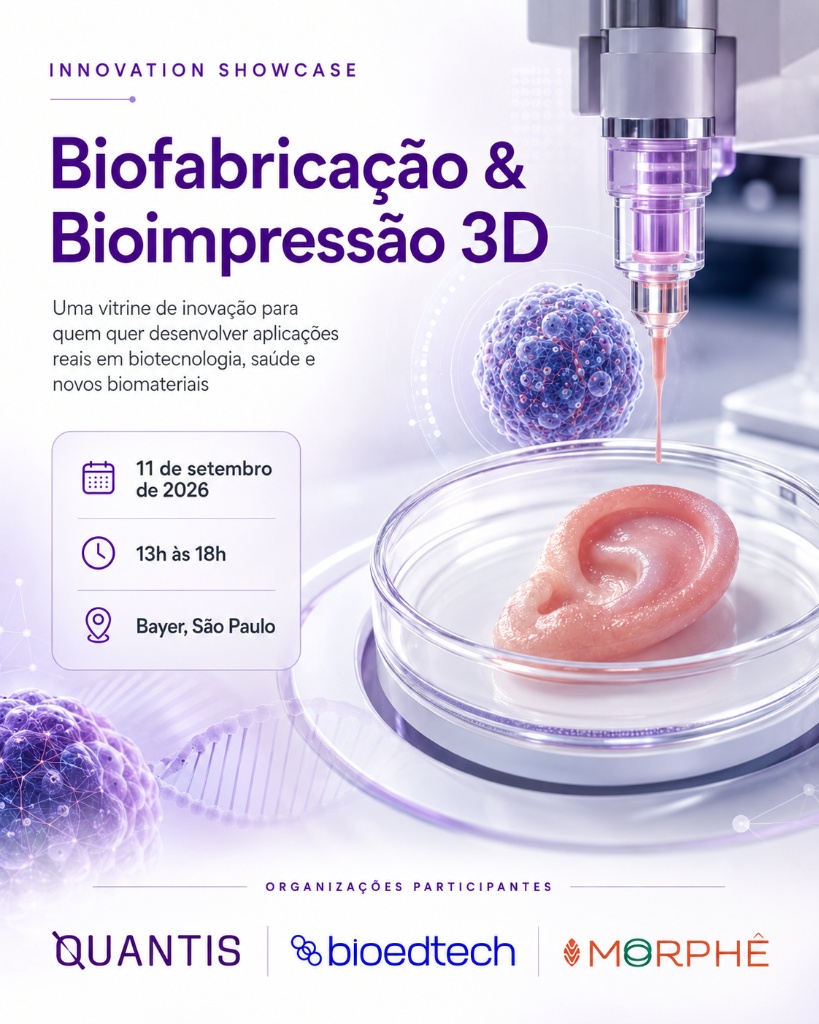
A biofabricated ear by Quantis — an original piece built in a hands-on course, real science and not AI-generated

Original Quantis piece · built in a hands-on course

Proof & credibility

Real science. Not a render, not AI.

The biofabricated ear that opens this page is an original Quantis piece, built live in a hands-on course — real biomaterial, scaffold and structure. It's the difference between talking about biofabrication and putting it on the table.

Real pieces in live demonstration

You see, touch and understand — applied biofabrication, inside Bayer, in a limited space.

Scientific and regulatory grounding

3D models, organoids and reconstructed skin anchored in literature and in milestones like the FDA Modernization Act 2.0 and the OECD.

Presented by Quantis · BioEdTech · MORPHÊ

Three fronts — biofabrication, education and 3D food — already working with academia, industry and technical training.

I want this for my operation
I want to join

Secure your place at the Innovation Showcase.

Only 7 seats. These are hands-on demonstrations held in a limited-capacity space inside Bayer. Complete your registration and then the payment — your seat is only guaranteed after payment confirmation.

Step 1

Register your participation in the form beside

Step 2

Complete the payment to secure your seat

  • September 11, 2026 · 1:00 PM to 6:00 PM
  • Bayer — São Paulo
  • Free on-site parking
  • 3D food demonstration and tasting
  • Post-event happy hour
  • Hosted by: Quantis · BioEdTech · MORPHÊ Foods

Investment

R$ 213.00

Sales closing · 7 seats
  • Technology kit about the technologies presented at the event
  • Exclusive gifts from the hosting organizations
  • Demonstration and 3D food tasting
  • Post-event happy hour
  • Free on-site parking
  • Full access to the demonstration circuit and networking
After registration, payment secures your seat. Only 7 seats — hands-on demonstrations in a limited-capacity space inside Bayer.
Pay and secure my seat (R$ 213.00)

Secure payment via Asaas · Pix, bank slip or card

After registration, payment secures your seat (only 7 seats).

By submitting, you agree that Quantis and the hosting organizations may contact you about the event.

Innovation Showcase

Made for those who want to see, understand and connect technologies with real application potential.

Applied science, real demonstrations, strategic networking and partnership opportunities — biofabrication and 3D technologies connecting science, industry and market.

Sales closing soon · only 7 seats left, secured by order of payment.