
Exploring 3D Organoid Models: A New Frontier in Biofabrication
- Janaina Dernowsek
- há 2 dias
- 4 min de leitura

The world of biomedical research and regenerative medicine is evolving rapidly. Among the most exciting advances are 3D organoid models. These miniature, lab-grown versions of human organs offer unprecedented opportunities for studying diseases, testing drugs, and developing new therapies. But what exactly are these models? How do they work? And why are they becoming essential tools across industries like cosmetics, pharmaceuticals, and veterinary medicine?
This article dives deep into the realm of 3D organoid models, exploring their significance, applications, and the cutting-edge technologies driving their development.Understanding 3D Organoid Models

3D organoid models are tiny, three-dimensional structures grown from stem cells. They mimic the architecture and function of real human organs on a miniature scale. Unlike traditional 2D cell cultures, these models provide a more realistic environment for cells to grow, interact, and behave as they would inside the body.
Why does this matter? Because the complexity of human tissues cannot be fully captured in flat, two-dimensional cultures. Organoids replicate the spatial organization, cell diversity, and microenvironment of organs, making them powerful tools for research.
For example, a liver organoid can metabolize drugs similarly to a real liver, allowing scientists to study drug toxicity more accurately. Brain organoids help researchers understand neurological diseases by replicating brain tissue development and function.
Key Features of 3D Organoid Models
Self-organization: Stem cells spontaneously arrange into structures resembling organs.
Cell diversity: Multiple cell types coexist, reflecting the complexity of real tissues.
Functional mimicry: Organoids perform specific organ functions, such as secretion or filtration.
Scalability: They can be produced in large numbers for high-throughput testing.
These features make 3D organoid models indispensable for industries that require precise biological models, such as cosmetics testing, pharmaceutical development, and regenerative medicine.

The Role of 3D Organoid Models in Industry
Industries are increasingly adopting 3D organoid models to improve product development and reduce reliance on animal testing. The cosmetics industry, for instance, uses skin organoids to test new formulations for safety and efficacy. This approach aligns with ethical standards and regulatory demands for cruelty-free products.
In pharmaceuticals, organoids accelerate drug discovery by providing more predictive models of human response. They help identify potential side effects early, reducing costly failures in clinical trials. Moreover, organoids derived from patient cells enable personalized medicine, tailoring treatments to individual genetic profiles.
Veterinary medicine benefits from organoid models by studying animal diseases and testing veterinary drugs in a controlled environment. Ophthalmology uses retinal organoids to explore eye diseases and develop novel therapies.
Practical Applications Include:
Drug screening and toxicity testing
Disease modeling and pathogenesis studies
Regenerative medicine and tissue engineering
Cosmetic ingredient safety evaluation
Personalized medicine development
The versatility of 3D organoid models makes them a cornerstone technology for advancing healthcare and life sciences.

How Technology Drives 3D Organoid Model Development
The creation and use of 3D organoid models rely on sophisticated technologies. Biofabrication techniques, such as 3D bioprinting, enable precise construction of organoids with controlled architecture. This is where platforms like QMatrix® come into play, offering human extracellular matrix-based biomaterials that support cell growth and organization.
Artificial intelligence (AI) also plays a crucial role. AI-driven platforms assist in optimizing bioprinting parameters, cell concentrations, and scaffold designs. This integration reduces trial-and-error, accelerates research, and ensures reproducibility.
One can explore online 3d organoid models to access digital platforms that facilitate remote design, simulation, and analysis of organoid cultures. These tools democratize access to advanced biofabrication, enabling researchers worldwide to innovate faster.
Essential Technologies Include:
Human extracellular matrix biomaterials: Mimic natural tissue environments.
3D bioprinting: Builds complex tissue structures layer by layer.
AI-assisted biofabrication: Optimizes protocols and reduces errors.
High-resolution imaging: Monitors organoid development in real time.
Together, these technologies create a powerful ecosystem for advancing organoid research and applications.
Challenges and Future Directions in 3D Organoid Research
Despite their promise, 3D organoid models face challenges. Reproducibility can be an issue due to biological variability. Scaling up production for industrial use requires robust protocols and quality control. Additionally, fully replicating the complexity of whole organs, including vascularization and immune components, remains a work in progress.
However, ongoing research is addressing these hurdles. Innovations in biomaterials, such as the development of hybrid scaffolds combining synthetic and natural components, improve organoid stability and function. Advances in microfluidics enable the creation of organ-on-a-chip systems that integrate multiple organoids, simulating systemic interactions.
The future points toward more sophisticated models that better mimic human physiology, enabling breakthroughs in drug development, disease modeling, and regenerative therapies.
Recommendations for Industry Adoption
Invest in training and capacity building to master biofabrication techniques.
Collaborate with technology providers to customize organoid platforms.
Implement AI tools to streamline research and development workflows.
Prioritize ethical sourcing of biomaterials and compliance with regulations.
Explore partnerships for scaling production and validation.
By embracing these strategies, industries can harness the full potential of 3D organoid models.
Transforming Biofabrication with 3D Organoid Models

The integration of 3D organoid models into biofabrication marks a paradigm shift. It moves beyond traditional cell culture and animal testing toward more precise, human-relevant models. This transformation supports the development of safer cosmetics, more effective drugs, and innovative regenerative therapies.
Companies like Quantis Biotechnology exemplify this shift by combining human extracellular matrix biomaterials with AI-driven platforms. Their approach ensures that biofabrication is not just about building tissues but engineering functional microenvironments that replicate human biology with precision.
While the field of organoids continues to evolve, one of the biggest barriers to large-scale adoption is not scientific understanding — but accessibility, cost, and reproducibility.
This is exactly where Quantis Biotechnology has positioned itself.
By developing low-cost, scalable solutions for the production of spheroids and organoids — including non-adherent micromold-based systems (QMicroNiches) — Quantis enables laboratories to generate standardized 3D models with speed, consistency, and reduced operational complexity.
Beyond organoids, the company is also advancing the production of tissue-inspired fibers and biofabricated filaments, expanding the possibilities of building controlled microenvironments for regenerative applications.
This approach reflects a broader shift: moving from complex, high-cost biofabrication toward accessible, reproducible, and industrializable solutions — without compromising biological relevance.
In this context, Quantis stands at the forefront of democratizing 3D cell culture and biofabrication, transforming what was once limited to highly specialized labs into a practical tool for innovation across healthcare, cosmetics, and biotechnology.


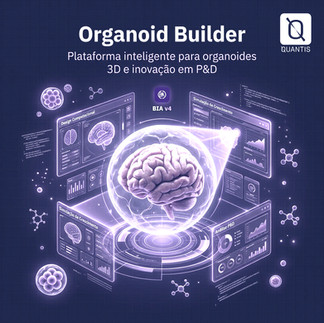


Mais informações: https://www.quantis.bio/organoids?lang=pt


Comentários